
DIGICHer Project Highlights Community-Centered Heritage Digitisation, Linguistic Diversity, and Inclusive Policy Frameworks Across Europe
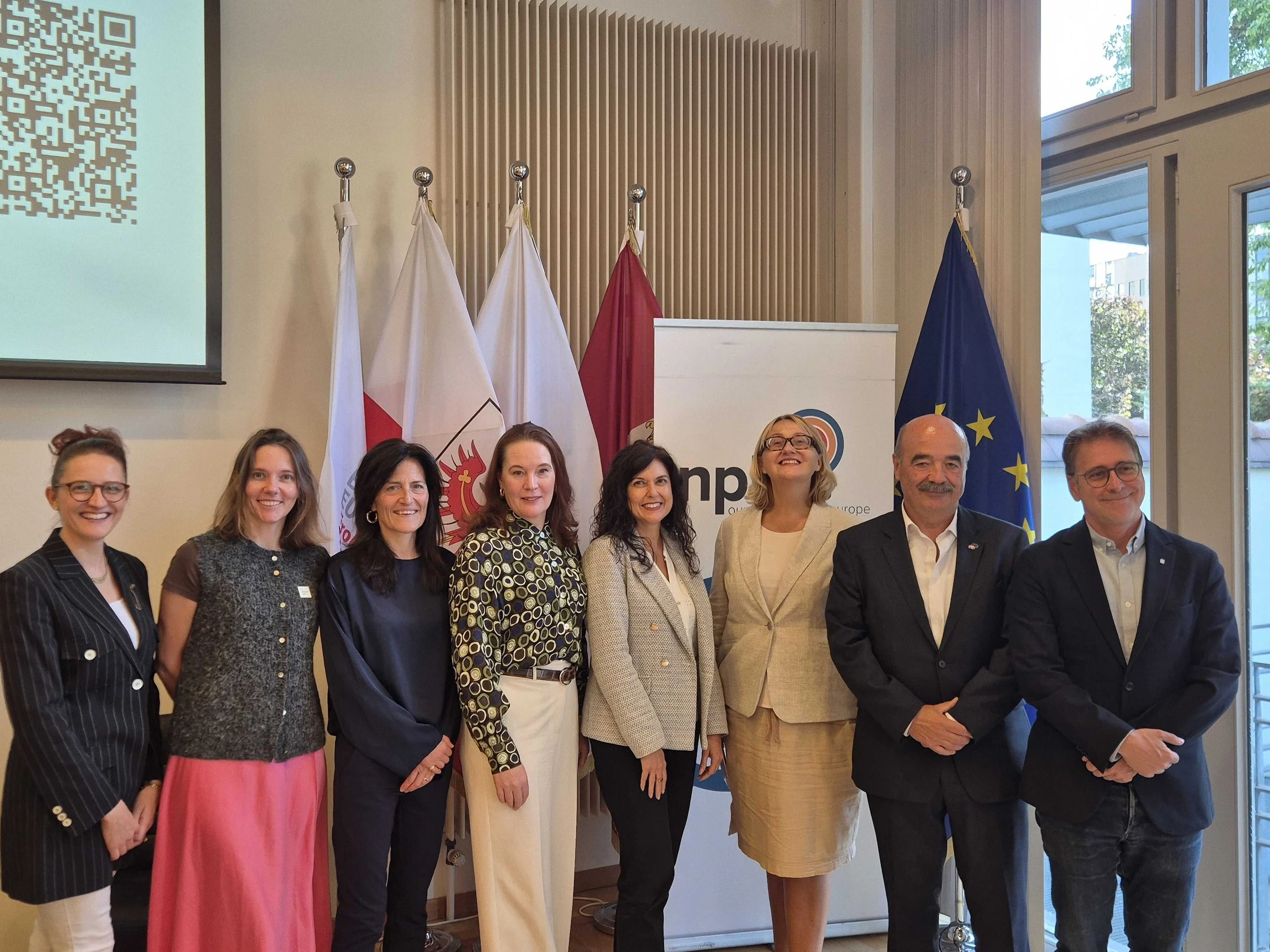
Speakers from NPLD and DIGICHer networking breakfast, Brussels 23 September 2026. CC-BY-SA
PRESS RELEASE: 23 September / Representation of the European Region Tyrol-South Tyrol-Trentino, Brussels
Representatives, researchers, and partners from the DIGICHer project recently convened at the Network to Promote Linguistic Diversity (NPLD) in Brussels to showcase project insights, community case studies, and strategic policy recommendations aimed at supporting, preserving, and promoting Europe’s rich language and cultural heritage.
Emphasising Literacy and Language Diversity
The initiative opened with welcome addresses from:
Anna Solé, Senior Expert - Multilingualism at the European Commission
Anna Jungner-Nordgren, Senior Advisor for International and Nordic Affairs at Folktinget and Chair of the Network to Promote Linguistic Diversity
Kristina Kovaitė, Professor in Economics at Vilnius Gediminas Technical University and DIGICHer Project Coordinator
The opening addresses focused on the importance of literacy, language diversity, and the necessity in supporting, preserving and promoting the richness of language and cultural heritage across Europe.
Quotes
‘’When we initiated DIGICHer, we knew we would face uncertainties, but we found far more, and far wider, issues to explore than we had anticipated. Now, in the project's final stage, we are glad to see minority communities and cultural heritage institutions joining the dialogue, which shows how much this work matters. We are encouraged by the European Commission's continued support for this field, which allows our work to go on ”
Kristina Kovaitė, Professor in Economics at Vilnius Gediminas Technical University and DIGICHer Project Coordinator
‘Literacy is more than a basic skill, it’s about connection. When we read in our own language we connect with our own communities, our history, our culture, and by sharing our literature we can also share our culture with others. This is the celebration of our linguistic diversity’’
Anna Solé, Senior Expert - Multilingualism at the European Commission
‘’NPLD is proud to be an associate partner of DIGICHer. This cooperation reflects something we strongly believe in. Linguistic communities themselves need to be part of the conversation about how their cultural heritage is preserved, presented and made accessible in the digital environment.’’
Anna Jungner-Nordgren, Senior Advisor for International and Nordic Affairs at Folktinget and Chair of the Network to Promote Linguistic Diversity
Reimagining Heritage Digitisation: Communities at the Center
Partners presented the DIGICHer project from various angles, detailing its goals to understand the opportunities, barriers, and risks of digitising heritage. The project aims to make recommendations on setting priorities, maintaining context for digital objects, ensuring long-term preservation, validating frameworks for digital asset use, and building capacity for digitally adept heritage institutions - with three communities at front and center.
Monika Mačiulienė, Senior Researcher at Vilnius Gediminas Technical University, provided background on the call by asking who controls memory digitisation, framing, and profiting from heritage assets. She noted that communities are typically brought in at the end of the chain—if at all—whereas DIGICHer starts with the community at the center of decision-making.
This approach is guided by the CARE Principles:
Collective Benefit
Authority to Control
Responsibility
Ethics
Three Communities, Three Unique Questions
The project centers on three specific communities, each addressing distinct challenges:
The Sámi: "Who controls the archive?" — The Sámi are the only indigenous people recognised within the European Union, with a long history of having their culture taken and described by others.
Jewish Communities: "Who is responsible when the community is dispersed?" — Jewish people have been living in Europe for more than two thousand years, continuously moving across the continent due to factors such as wars, persecution, and search for better life.
The Ladin: "Whose words describe it?" — The Ladin are an Alpine-language community of a few thousand situated in a valley where tourism typically dictates the narrative.
Regional Languages and Co-Creation
Sabrina Rasom, Director of Istitut Cultural ladin ‘Majon di Fascegn’, explored opportunities and challenges for regional and minority language communities with digital heritage and linguistic diversity through the lens of the project. Drawing on learnings from the Ladin community, she highlighted how digitisation acts as a mirror, building awareness of community evolution over time.
Rasom stressed that initiatives like DIGICHer help bridge the gap between everyday community life and academic research, and highlighted how the Ladin Cultural Institute "Majon di Fascegn" formally adopting the CARE principles in practice demonstrates that communities must serve as active co-creators rather than passive recipients of support.
‘’Digitisation of cultural heritage is, at its core, a community mirroring itself in its own identity, culture, language, and territory. At the precise moment people see themselves reflected from a new perspective, they begin to become fully aware of who they truly are… The DIGICHer project—for us in the Ladin community, as well as for our partner communities like the Sámi and Jewish groups—serves as a way of staring directly into this mirror to build a deeper awareness. While minority communities often sense a gap between daily life and the technical work of academics, initiatives like DIGICHer provide the means to bridge this divide’
Policy Recommendations and Implementation Strategies
Rosa Ballardini, Professor of Intellectual Property Law and Vice Dean (Research) at the University of Lapland, presented the project's recommendations and implementation strategies tailored for three key audiences: minority communities, cultural heritage institutions, and policy and decision-makers.
Ballardini focused on the recommendations for Policy and Decision-Makers which provide legislative, governance, and funding guidance to enable equitable and participatory digitisation. These are accompanied by practical implementation steps, supported by DIGICHer tools, and a tailored CARE Principles Checklist to assess whether policy frameworks properly address collective benefit, authority to control, responsibility, and ethics.
Upcoming Next Steps and Events
As the framework enters its testing and expansion phase with additional communities, several upcoming events and workshops are scheduled:
15 October 2026 (Kaunas): “Digitised. Now What?” — A day for communities and institutions featuring the Jewish Heritage Network and the Sugihara House Museum, marking the beta launch of the refugee archive.
9–10 November 2026 (Inari): The Sámi Event — Held and reported in Finnish and Sámi, in collaboration with the National Archives of Finland and the University of Lapland.
12 November 2026 (Online): Europeana Project Month - The session will present some key results from the DIGICHer project, focusing on its recommendations, implementation strategies and guidelines. It will show that responsible digitisation of minority and Indigenous cultural heritage requires coordinated action by policy makers, cultural heritage institutions and communities.
Through January 2027: Webinars and Future-Scenario Workshops — Open to communities and institutions seeking to run the framework on their own collections and plan their heritage strategies for the next twenty years.
Project information
DIGICHer (Digitisation of the cultural heritage of minority communities for equity and renewed engagement), is an ambitious project funded by the European Union’s Horizon Europe programme. Running from February 2024 through to January 2027, DIGICHer focuses on the legal, political, socio-economic and technological factors that shape how minority cultural heritage is digitised and presented online, and aims to place minority groups at the centre of cultural heritage digitalisation efforts. Key project objectives include:
Developing a practical, scalable framework that promotes equitable, inclusive and diverse representation of digital cultural content.
Delivering evidence-based policy recommendations that support sustainable, respectful digitisation practices.
Collaborating with representatives from the Sámi, the Jewish people and the Ladin people to co-create methodologies that reflect their cultural values and priorities.
DIGICHer is coordinated by Vilnius Gediminas Technical University (Lithuania), in partnership with leading cultural heritage organisations and academic institutions across Europe, including the Europeana Foundation, Jewish Heritage Network (Netherlands), Friedrich-Schiller-Universität Jena (Germany), University of Lapland, National Archives of Finland (Finland), Istituto Italiano di Studi Germanici and Istituto Culturale Ladino (Italy), with associate support from the Network to Promote Linguistic Diversity (Belgium) and the Time Machine Organisation (Austria).
Contact Information
Nicholas Jarrett (nicholas.jarrett@europeana.eu)
Media
Some images that can be used can be found here, the attribution for them is:
Title: Images from NPLD and DIGICHer networking breakfast, Brussels 23 September 2026. Creator: DIGICHer project
License: CC-BY-SA
Further reading
Discover the DIGICHer project at digicher-project.eu
